How Could Inflation Impact Corporate Retirement Plans?
October 6, 2022 •
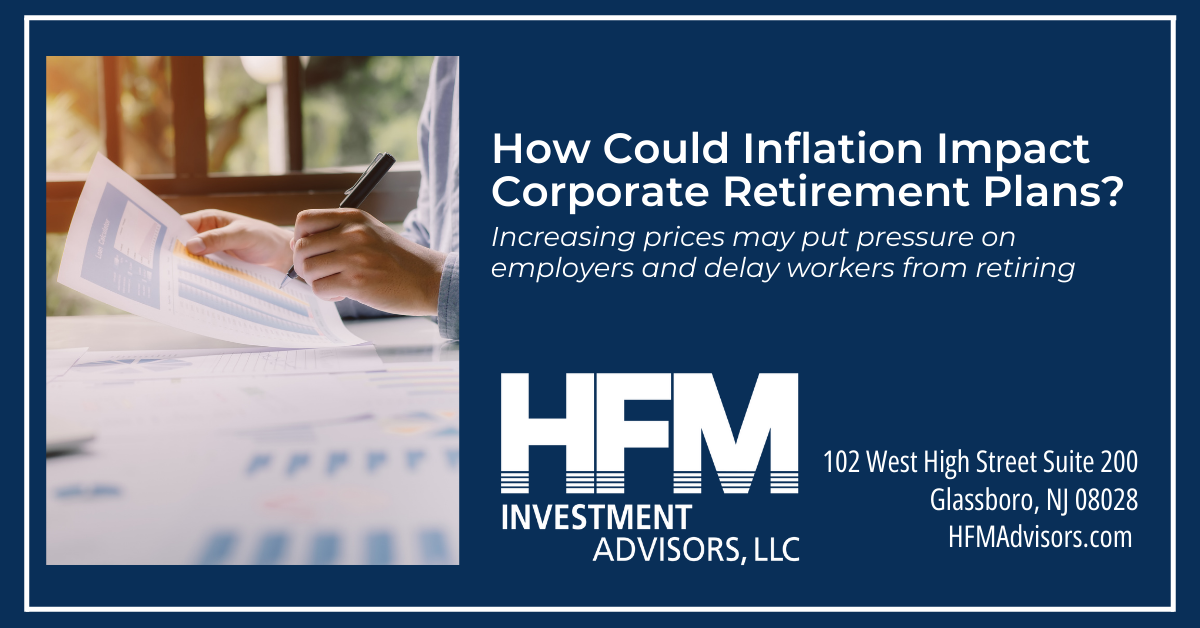
Inflation is the increase in the general price of goods and services, which can decrease the purchasing power of American workers. So how does this recent upward trend affect your workplace benefits, employees and retirement plan?
SALARIES, FLEXIBILITY AND SAVINGS
When inflation goes up, the same paycheck doesn’t stretch as far. With the increased costs of food & beverage, transportation, housing, apparel, medical care, recreation, education & communication and other goods & services, your employees might not be able to afford the same lifestyle.
To maintain a similar standard of living, your employees may request salary increases and it might be more than the typical 2% raise (year-to-date salary increases have been more than 4%).[1]
Other employers, however, are considering shortening the workweek as opposed to a salary increase.[2] Benefits like flexible schedules may be appreciated more than a raise.
Another employee benefit that is gaining interest is the emergency savings account. Sixty percent of employers said they are interested in offering emergency funds and 1 out of 4 employees said they’d consider a job change if a new employer offered this benefit.[3]
ROBBING PETER TO PAY PAUL
Increased costs may cause your employees to redirect funds designed to be saved for retirement. Whether it is reducing their current retirement deferrals and/or an increase in loan requests, it may be a way to keep up with the rise of inflation.
DELAYING RETIREMENT
Starting this year, all participants will receive a statement that includes a monthly income projection. The income illustration will be based on their retirement savings and lifetime payout assumptions. But what happens when those numbers are much lower than anticipated?
Older employees may feel additional savings worries, inflation stress and they could potentially delay their exit from the workforce. It is projected that 79% of older generations will react negatively to their predicted monthly retirement income.[4]
To prepare them, education is key. Emphasize the financial resources that come with your retirement plan, including our services and resources like participant infographics.
HEDGING FOR INFLATION
Companies and workers are likely to feel instability during this time of inflation-driven economic swing and may need extra support.
Here are some helpful solutions for your company’s retirement plan:
- Explore portfolio diversification to include investments that may be correlated to inflation[5]
- Consider a financial wellness program that educates employees on topics like inflation
- Get creative with contributions — 70% of workers support a 3% 401(k) contribution over a salary increase[6]
- Stay in close contact with our team to track evolving trends
Here are suggestions for participants of all generations to keep retirement savings on track, despite inflation:
- Utilize budgets for each area of monthly spending
- Prioritize where extra funds are allocated
- Promote healthy savings habits because 9/10 of employees believe their workplace retirement plan is one of the most important benefits[7]
- Speak with a financial advisor to review current investments and goals
ON THE HORIZON
To calm inflation fears, employers can provide financial wellness resources to help employees focus on their long-term financial objectives, which in turn can also improve retention rates and onboarding new hires.
Other benefits to consider include flexible work arrangements, remote work options, additional sick time and/or access to emergency savings so employees can concentrate on the present.
Inflation, unfortunately, is a part of our society and most likely will be a factor for the foreseeable future. Whether it’s high or low, a best practice is to continually explore ways of improving and protecting plan assets for your retirement plan and its participants.
HOW WE CAN HELP
Employers, contact us to discuss how your plan can meet business goals and motivate employees to save more for retirement.
Reach out to us today to explore opportunities.
102 WEST HIGH STREET, SUITE 200
GLASSBORO, NJ 08028
This information was developed as a general guide to educate plan sponsors and is not intended as authoritative guidance or tax/legal advice. Each plan has unique requirements, and you should consult your attorney or tax advisor for guidance on your specific situation.
©401(k) Marketing, LLC. All rights reserved. Proprietary and confidential. Do not copy or distribute outside original intent.
[1] Kropp, Brian, and Emily Rose McRae. “11 Trends That Will Shape Work in 2022 & Beyond.” Harvard Business Review, 13 Jan. 2022.
[2] Kropp, Brian, and Emily Rose McRae. “11 Trends That Will Shape Work in 2022 & Beyond.” Harvard Business Review, 13 Jan. 2022.
[3] Dhue, Stephanie. “No Emergency Savings? New Workplace Benefits Aim to Help.” CNBC, 7 Jan. 2022.
[4] Cohen, Josh. “Lifetime income illustrations: Preparing for participant reactions.” PGIM. Summer 2021.
[5] Chalk, Steff. “Retirement Planning Trends on the Horizon for 2022.” 401kTV.com , 15 Dec. 2021.
[6] American Century Investments. “8th Annual Survey of Retirement Plan Participants.” 2020.
[7] American Century Investments. “8th Annual Survey of Retirement Plan Participants.” 2020.