
How Financial Stress Impacts Your Company
April 18, 2023 •

Financial stress is having a profound impact on workers, and in turn, New Jersey business leaders. Stressed employees are feeling the pinch; this can affect productivity, retention, and engagement at work. Financial education could be an easy solution that helps your employees and overall business.
Many employees are having a difficult time coping with financial stress. Weathering the last several years – a pandemic, geopolitical tensions and economic uncertainty – has only exacerbated their stress levels.
Unsurprisingly, elevated stress carries into the workplace impacting operational costs including retention, mental health expenses, productivity and the company’s bottom line.
Inflation, Debt and Economic Uncertainty
Over the past year, inflation has been a significant source of stress. Its effects reach far and wide – from influencing spending decisions to impacting retirement security.
This is evident in revolving credit card debt. American consumers seem to be reaching for the plastic with more gusto. Between 2021 and 2022, the average credit card debt rose by 15%, the highest rate of increase in more than 20 years.[1] This brings the average credit card debt per person to $5,525.[2]
As an alternative to credit cards, a new debt source, “buy now, pay later” services are gaining popularity. Online shoppers may be drawn in by the attractive promise of interest-free payments. But this may be a trap. Users may end up paying more for their purchases as fees are added to late payments, sometimes leading to a much steeper cost than anticipated.
Americans also feel their retirement savings affected by the current state of the economy. More than half say they are not where they need to be for retirement with one-third indicating they are “significantly behind.” They overwhelmingly point to inflation as the reason.[3]
Financial Stress Follows Employees to the Workplace
One thing is certain: financial stress does not stay at home. Employees have long brought money issues into work. Terms such as “quiet quitting” and “the Great Resignation” have entered the business lexicon, seeking to explain recent worker trends and employment changes.
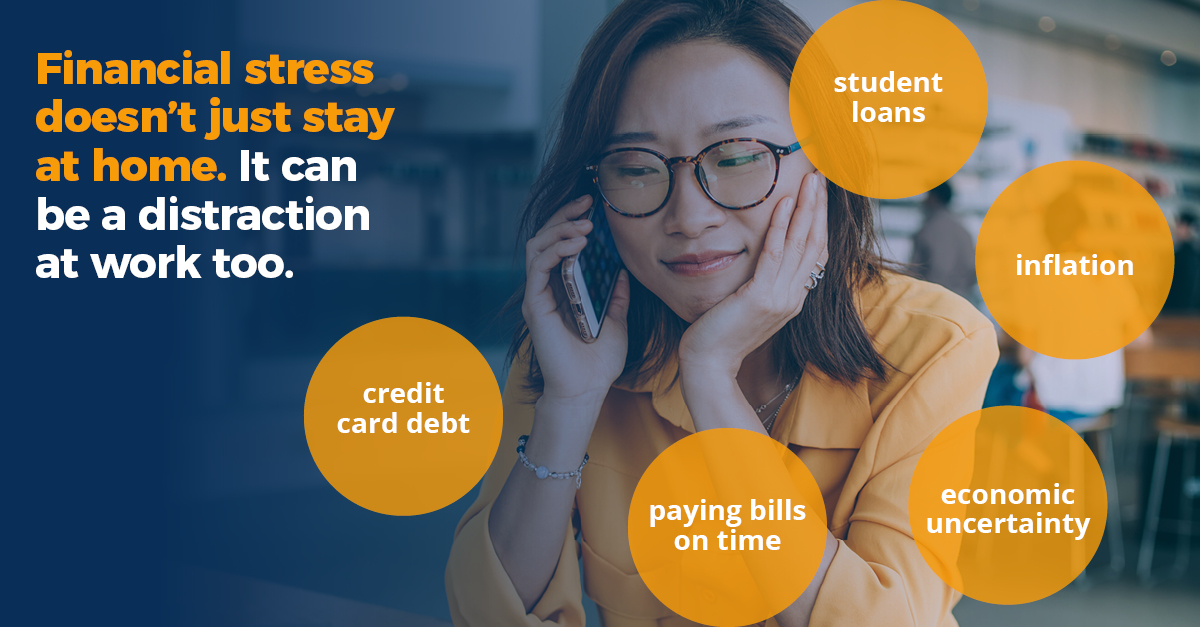
A recent survey found that employees say that financial stress and money worries over the past year have had a severe or major impact on their mental health, company loyalty and overall work performance. Financially stressed employees are:[4]
- 2x as likely to look for another job
- 6x more likely to say stress has reduced their productivity
- 7x more likely to say stress has impacted their attendance
- less likely to feel valued at work
Financial security has a powerful impact on employees within the workplace. There seems to be an undeniable connection between financial worry and employee satisfaction, indicating that managing finances is critical for job concentration and success.
Financial Wellness and Education for the Win
Introducing or enhancing your company’s financial wellness program can be a great way to help ease the financial strain on employees and bolster loyalty. Since money management skills are often the root cause for financial stress, a financial wellness program could help employees where they need it the most. At HFM, we offer financial wellness tools and resources designed to engage employees and put financial freedom within reach. HFM Ignite financial wellness is available to all our clients, free of charge!
More than ever, lowering your employee’s financial stress is not only important for their mental well-being but also for their contributions to the workplace, your business, and beyond.
HFM Investment Advisors, LLC.
856-232-2270
401kteam@hfmadvisors.com
102 West High Street Suite 200, Glassboro, NJ 08028
Investment advisory services are offered through HFM Investment Advisors, LLC, a registered investment adviser. Please remember that securities cannot be purchased, sold or traded via e-mail or voice message system. This email transmission and any documents, files, or previous email messages attached to it may contain information that is confidential or legally privileged. If you are not the intended recipient, you are hereby notified that you must not read this transmission and that any disclosure, copying, printing, distribution, or any action or omission of this transmission is strictly prohibited. If you have received this transmission in error, please immediately notify the sender by telephone at 856-232-2270 or return and delete the original transmission and its attachments without reading or saving in any manner.
This information was developed as a general guide to educate plan sponsors and is not intended as authoritative guidance or tax/legal advice. Each plan has unique requirements, and you should consult your attorney or tax advisor for guidance on your specific situation.
©401(k) Marketing, LLC. All rights reserved. Proprietary and confidential. Do not copy or distribute outside original intent.
[1]Federal Reserve Bank of New York. “ Total Household Debt Reaches $16.51 trillion in Q3 2022; Mortgage and Auto Loan Originations Decline.” 15 Nov. 2022.
[2] Hanson, Savannah. “Average Credit Card Debt in the U.S.: Statistics for 2022.” Annuity.org. 5 Dec. 2022.
[3] Royal, James. “Survey: 55% of working Americans say they’re behind on retirement savings.” Bankrate. 24 Oct. 2022.
[4] PwC. “2022 PwC Employee Financial Wellness Survey.” May 2022.